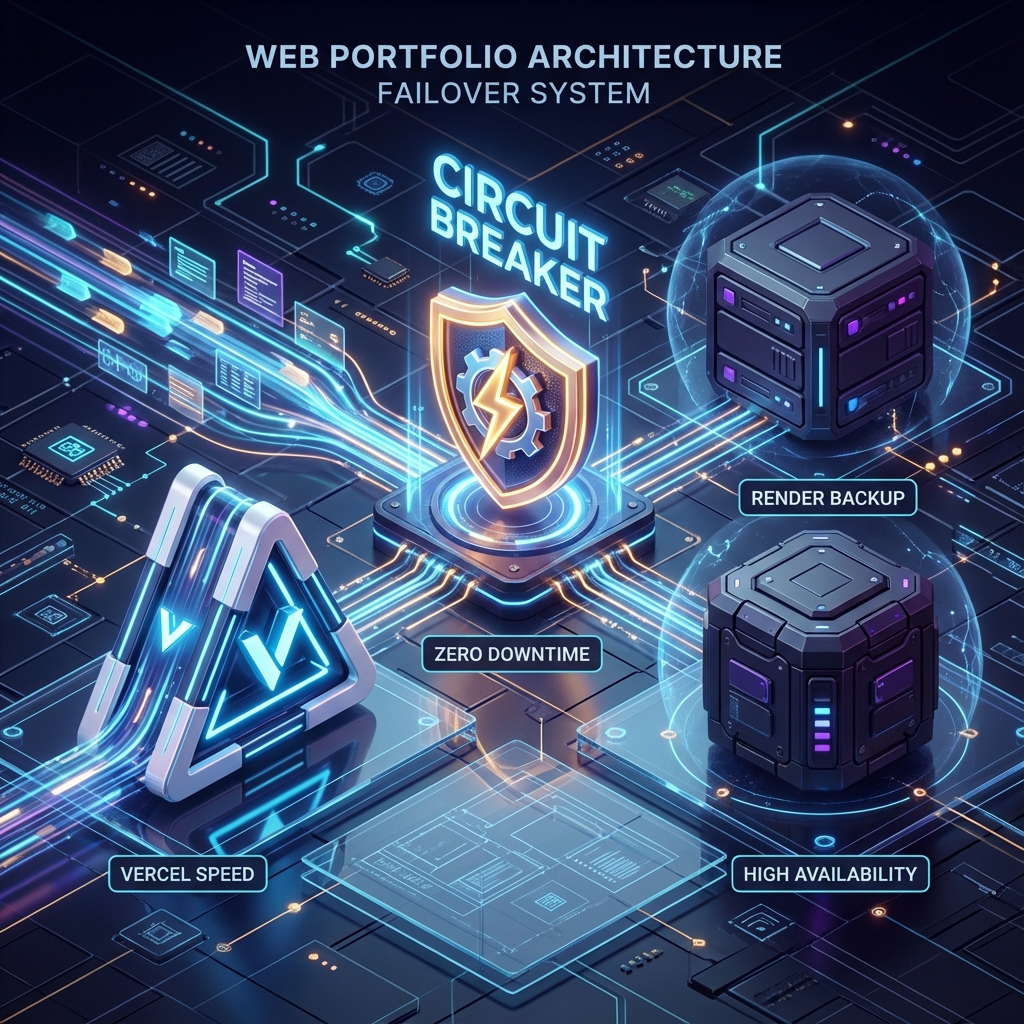
Escaping the 503: How I Architected a Zero-Downtime Portfolio for $0
It was New Year's Eve, 2025. I was ready to relax, and wait for the countdown 🎆. I opened my portfolio to check something, and there it was:
503 Service Unavailable
My backend, hosted on Render's free tier, had been suspended. I had hit the monthly uptime limits. My Resume, my Projects, my AI Chatbot—all dead. 💀
I had two choices:
- Pay $7/month: The easy, boring way.
- Over-engineer a solution for $0: The fun, educational way.
Obviously, I chose option 2. Thus began the journey to architect a Zero-Downtime, Multi-Cloud Failover System.
🛑 The Problem: Active Servers cost Money
I run a FastAPI (Python) backend. Unlike Node.js, Python apps traditionally run in containers (Docker).
- Render: Great for containers, but the free tier spins down after 15 minutes of inactivity and has a monthly runtime cap.
- Heroku: No longer free.
- AWS/GCP: Complexity overload for a portfolio.
I needed a place to run Python that was Fast, Always On, and Free.
🔍 Exploration: Finding a New Home
I explored several options:
1. Koyeb
Verdict: Good, but strict limits. Koyeb is a modern platform similar to Render. It offers a "forever free" tier, but it requires credit card verification (a friction point) and still runs as a container that consumes resources. It didn't feel significantly different from Render's constraints.
2. Fly.io
Verdict: Too complex for tonight. Fly.io is amazing, but managing persistent volumes and regions manually was more ops work than I wanted for a static portfolio backend.
3. Vercel (The Wildcard)
Verdict: The Winner via Serverless. 🏆 We usually think of Vercel for Next.js/Frontend. But Vercel supports Python Serverless Functions.
- Pros: Infinite scaling (to a point), generous free tier, insanely fast cold starts compared to containers.
- Cons: No persistent filesystem, no background tasks, 10-second timeout.
🛠 The Architecture: Active-Passive Failover
I realized I didn't have to choose one. I could use both.
Validating Vercel for Python
Migrating a standard FastAPI app to Vercel requires some tweaks. You can't just pip install.
vercel.json: You need to tell Vercel to treatapi/index.py(ormain.py) as a serverless entry point.- Secrets: My app uses
firebase-adminsdk which needs a JSON key file. Vercel's file system is read-only.- Solution: Minify the JSON key into a single Environment Variable string and parse it in memory.
The "Circuit Breaker" Frontend
This is where the magic happens. I modified my frontend API client (api.ts) to be smart.
Instead of hardcoding one URL, I gave it two:
PRIMARY_URL: Vercel (Fast, Serverless)BACKUP_URL: Render (Slow, Container)
I wrote a wrapper function fetchWithFailover:
typescriptasync function fetchWithFailover(endpoint, options) {
  try {
    // Try Primary (Vercel)
    return await fetch(`${PRIMARY}/${endpoint}`, options);
  } catch (error) {
    console.warn("Primary failed, switching to Backup 🛡️");
    // Fallback to Secondary (Render)
    return await fetch(`${BACKUP}/${endpoint}`, options);
  }
}
Now, if Vercel ever hiccups (or I break it), the request seamlessly retries on Render. The user never sees an error.
🚀 The Result
I deployed the changes at 12:05 AM, Jan 1st, 2026.
- Primary Backend: Vercel. My API responses dropped from ~2s (Render cold start) to ~300ms.
- Backup Backend: Render. It sits there, sleeping, ready to wake up if Vercel fails.
- Cost: $0.00.
What about "Heavy" Tasks?
The only downside? Serverless functions can't run background threads (like my "Ingest Knowledge Base" task that parses PDFs).
- Solution: Since I only update my resume once a month, I run the ingestion script locally or hit the Render endpoint explicitly for that one admin task. For everything else (reading blogs, projects), Serverless is king.
💡 Key Takeaways
- Don't rely on one cloud provider. The free tier allows you to diversify.
- Serverless Python is underrated. For read-heavy REST APIs, it beats containers on cost and speed.
- Smart Frontends save Backends. A customized
fetchwrapper is better than a 503 error page.
Happy Coding, and Happy New Year! 🎆